October 27 morning: one core concept at a time
1. What are enumeration countermeasures?
Query functions in DNS, SMB, SNMP, LDAP, and RPC support normal operation, but may also reveal hostnames, accounts, shared resources, or service endpoints.
Enumeration countermeasures control who can obtain which information or perform which operations, and from where.
Think of a company reception desk: public opening hours can be shared, but visitors should not receive all internal employee information. The goal is to make responses match operational needs and security policy, not to make every query fail.
2. Where are they used, and what should be established first?
They support authorized asset inventories, security reviews, and configuration changes. First establish:
- Which services are necessary?
- Which sources and identities need access?
- Which information and operations must be available?
- What should be public, and what should be restricted?
Public DNS records for a website are usually necessary; visible information alone does not establish a vulnerability. Ordinary DNS queries and AXFR zone transfers are different functions: normal resolution can remain available while zone-transfer recipients are restricted. RFC 5936
3. Look at several layers of defense
Layer one: services and networks.
Disable unnecessary functions and allow management-service connections only from necessary sources. Check dependencies first instead of closing every visible port.
Layer two: identity and permissions.
Authentication establishes who you are; authorization determines what you may do.
Least privilege grants only the permissions needed for a task. Monitoring staff need to read device status, which does not imply a need to change device settings. NIST SP 800-53, AC-6/CM-7
Layer three: data and transport.
Restrict returned fields, shared content, and management objects, and protect transport. Encryption does not automatically narrow query permissions; LDAP signing primarily protects integrity and is not encryption. Microsoft LDAP signing
Layer four: maintenance and monitoring.
Use supported versions, patch vulnerabilities, retain appropriate logs, and review unusual queries and permission changes. Changing ports or hiding version information can only supplement real access restrictions. NCSC guidance
4. A concrete example: preserve monitoring, restrict guests
This is a synthetic tabletop scenario. No device was operated.
A company switch needs to let a monitoring host on the management network read status through SNMP. The guest network does not need this function. An authorized review nevertheless finds that guests can query the device name.
This establishes only that this source and identity obtained the name in this query. It does not establish permission to change settings or administrator access.
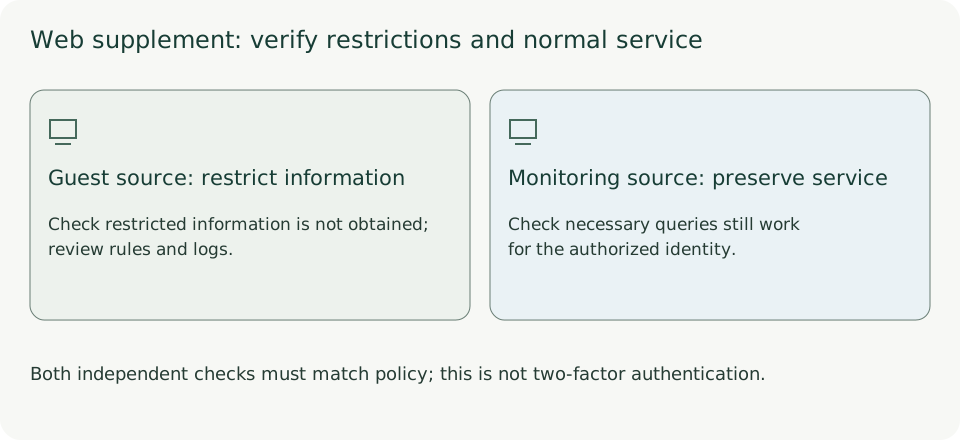
After adjusting source restrictions and query permissions to match requirements, the administrator must verify both sides:
- Can guests who should not have access still obtain restricted information?
- Can the monitoring host that should have access still perform necessary queries?
If guests can no longer query but monitoring is also broken, the correction does not yet meet requirements. These are tests of allowed and denied access, not two-factor authentication.
Both independent checks must match policy; this is not two-factor authentication.
- Guest source: restrict information
Check restricted information is not obtained; review rules and logs.
- Monitoring source: preserve service
Check necessary queries still work for the authorized identity.
5. How should evidence be interpreted?
Record configuration changes separately from verified behavior. Preserve the check time, source, test identity, service, operation, response, and relevant logs; do not record passwords or authentication secrets.
A single timeout establishes at most that no response was received on this attempt. Network failure or a service outage may also explain it, so it does not establish that all unauthorized access is blocked.
A more precise conclusion is: under the specified sources, identities, and query items in this test, restricted information was no longer obtained and necessary monitoring still worked. Do not describe limited tests as proof that the entire system is absolutely secure.
Quick check:
After a rule change, a guest query times out. Why is that insufficient to declare the defense complete? Name one additional piece of blocking evidence and one normal-function check.
One or two sentences are enough. The 12 core concepts plus seven optional topics are this series' teaching design, not an official fixed count. The next core concept belongs to M05.
Concept Q&A
Pending: related questions will be edited into anonymous teaching notes when available.